

I Finished The Wire Yesterday
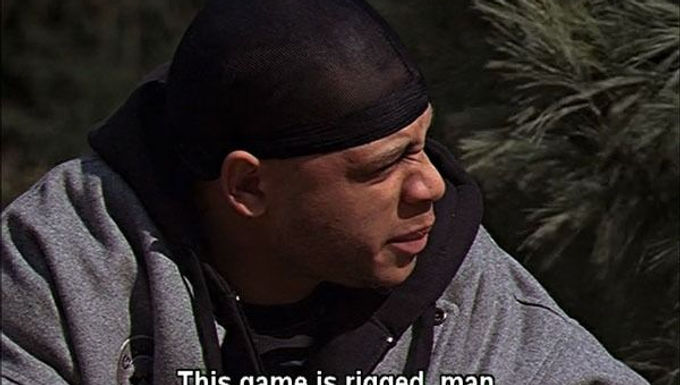
I finished The Wire yesterday. HBO’s golden child and to many, the peak of fictional television. I think I understand it. I think I understand why it has the reputation it does, I think I understand why Barack Obama sat down with the show’s creator to dissect it after calling it one of the ‘greatest pieces of art of recent decades’ and why it was nominated for sixty Emmys.
With The Wire, It all lies beneath the story. It’s all in the innuendos and subtleties which consistently force the plot to go one way and in doing so, reveal so much about society and the world we live in that the show can be extrapolated and used to analyse any aspect of modern life, in any context.
For the purpose of not spoiling The Wire for those who haven’t watched it, I’ll try and be as vague as possible whilst also trying to paint a vivid picture of the main idea that I took out of the show.
It’s based in Baltimore, a city in Maryland. A city on its deathbed being ransacked by crime every day of its sad existence. It follows the Boston Police and their attempts to reduce the crime and it follows the criminals - the kids and the drug dealers who administer pain and violence on the city whilst being victims of something sinister themselves. Quickly, you realise that the line between the good guys and the bad guys isn’t that it’s not so much there, but it doesn’t really exist.

It’s real life, where nobody’s purely good and everybody’s flawed. It points the blame at society as a whole for the state of the city, and despite the police’s best efforts, it’s a state that remains stuck and unyielding. One of the running themes throughout the show is that we see good, talented people swallowed up and spat out by the all-encompassing ‘system’. That can be the school system, the political system or on the streets. The show made no attempt to hide its belief that talent is only at the mercy of other powers when it comes to fulfilling powers
Those institutionalised powers are what transcends the show towards being a complete reflection and a critique of modern life. It demonstrates how two of the most talented police officers in the show, despite their obvious talents, are left at the end with absolutely nothing due to their refusal to play the game how others want them to play it. It shows how the officers with careers’ rife with mistakes and stupidity are the ones who land on their feet because they lied and lucked their way to the top. It shows how the purity of politicians with real ambition to make change never stood a chance to do so. It reveals that talent and good intentions perhaps hardly matter in the real world.
That’s one of the main things I took out from the show anyway. And art is up to interpretation, so that’s not adefinitive analysis. But it’s mine.

This isn’t actually about The Wire. Well, it is - but it’s not really. This is about why, as you pay more and more attention to the things you love and discover more and more of them, the childlike wonder begins to seep out of you to be instead replaced by confusion and resentment.
The last three or four months, which have coincided with the summer transfer window, have been a torrid time for those who pride themselves on having extensive knowledge of European football. Because paying so much attention to the world outside the Premier League will quickly make you realise that there are so many talented footballers outside the Premier League.
But the ones with the power to actually do something about it, didn’t care. The top Premier League clubs, the ones with the funds and allure to bring whoever they pleased to them just threw it all away for Premier League experience. Trying to make sense with whatever the 2026/27 transfer window was, is an impossible task. Money seemed to be worthless. Scouting seemed to be worthless. The smaller sides put the larger ones to shame with their business and that’s weird because usually it works the other way round.
But once you look at it in a different lens, a lens encapsulated by the same control, egos and greed which were prominent in The Wire, the window to me, and the state of football in general, becomes much easier to digest.
The first place to start is with the owners. The owners have all the control and power to dictate where their club goes and how their club operates. Usually, the primary target of owning a business is making profit from that business. In The Wire, the equivalent of the owners, the ones able to really drive change, were the politicians.

In the show, these people were ostensibly making continuous public declarations that the crime in Baltimore would improve but it soon became obvious that these same people’s intentions were predominantly selfish. It was their career trajectory and the deceitful dealings they made with others in order to climb up the ladder which kept them up at night. It was the power and the appearance of seeming powerful which they needed. As a result, the crime never got better and all the most talented people in the police department were trapped in a world aiming to destroy the risks they took and the creativity they possessed to win cases.
What does this have to do with football? Well, in 2022 BlueCo arrived at Chelsea and upon arrival, promised a dawn of a new era where The Blues would once again sit on top of the football world. Fans were excited and the rest of the league stood on watch to see how they’d go about achieving this new utopia. It’s been 4 years since then and Chelsea, despite spending far and away more money than the rest of the league, haven’t finished in the top 3 once.
In fact, it’s hard to say right now if they’ve even improved since BlueCo’s arrival. Performances in the league have been tirelessly inconsistent and they haven’t managed to get past the Champions League quarter finals since the ownership's debut season. But do you know what has stayed consistent? The money. The money flowing in and out of the club for the last four years has been somewhat of a revelation in England. Chelsea keep spending and spending and keep selling and selling and nobody can do anything about it.
The squad has hardly got better though and that doesn’t make sense. So there becomes a point where you wonder what is actually going on here. If your intention was to put the team in a better place of winning trophies and being successful, surely after £2 billion spent, you would have done. Or was that the intention? What if, like the power-bearers in The Wire, it’s just a facade? What if the aim of the game for these private equity investors in charge of Chelsea is the aim of the game for all private equity investors. Make profit. Selfish intentions perhaps holding Chelsea back are mirroring the ones which gripped the city of Baltimore and didn’t let it go.

The removal of PSR and its replacement being even more lenient financially on clubs has meant that more and more is being spent, there’s more and more in-house trading but hardly anyone is getting better. Weird. The days of shrewd, ahead of the curve signings which wove together the best of data-driven analysis and the best of in-person scouting and methodical research, they don’t exist at the apex of the league anymore.
Those Firmino to Liverpool-esque signings or the Heung-Min-Son’s to Spurs deals , the uncut diamonds who were on the precipice of shining so brightly with a bit of time and patience - those signings were nowhere to be seen in the summer. There seems to now be an inverse correlation between scouting and how much money a club has because every big signing seemed to be a fortune on a player who’d played in the Premier League.
If people who watch football in their spare time, whether it’s the casual fan or social media scouts and analysts dreaming of a break, if they all knew that Mamadou Sangare, playing every week for a Lens team that finished second in Ligue 1, was a fantastic player - then how didn’t the directors and scouts with the access to unlimited resources and knowledge not know?
Or was it that they didn’t care? Those talented players are obviously out there if you care to look, but the biggest clubs just don’t appear as though they want to.
Why could everyone who’d watch Victor Gyokores at Sporting and anyone who knew anything about football say unequivocally that he was going to be a bad misallocation of funds for Arsenal yet those in charge of the club, who should know more than us, still decided to sign him.
Can they not judge good and bad players anymore?
That brings me to the coaches, many of whom still have a say in who the club signs, another question occurred to me. Do they want the best players in their team or do they want the players that fill their role the best?
There’s two transfers that spring to mind this summer. Two occasions where managers pleaded for certain players to join their squad because they were so pivotal to their plans. Enzo Fernandez to Man City and Sandro Tonali to Spurs. In these cases, it was well reported that these £100 million signings were because of the manager and the manager alone. And if that’s the case, when managers of these mega clubs are so desperate to have these players join their squad, you’d think that these players must be seriously special footballers who will elevate them almost instantly.

But it’s almost the lack of superstardom, the lack of ingenuity and spark which looks to be the reasons why they were brought into these clubs. It was the other side of the coin, the grit, the intensity and the conformity which made them so attractive. Tonali was signed for £100 million pounds not because he is a superb footballer, but because he runs hard, covers a lot of ground and is reliable. Enzo was signed because, although he was important for Maresca at Chelsea, it’s his tactical understanding and versatility which was so desired.
That’s not to say those traits aren’t valuable. But those traits can be learned and trained. Being a genius can’t. That’s why typically you’d assume the most expensive players to be the geniuses.
Neither Enzo or Tonali are world-beaters, and if Enzo Fernandez might’ve been once, it’s not the things that made him a world beater which Maresca wanted to get his hands on - the passing and playmaking, it was all the other stuff. In these three cases, if managers are making a b-line for players who are hardly remarkable, who are being lusted over due to their physicality instead of their skill, what does that say about managers and what does that say about the game?
The question beckons as to if managers want to be seen at the centre of the club’s success as opposed to the players, to get a taste of the limelight their idol Pep had in his clutches for over 15 years. If they think the way to do that is by signing players they know will keep it simple and carry out their instructions robotically, then it makes sense why these players were signed.
The Cody Gakpo transfer saga late into the window reflected this point entirely. Nobody watches Cody Gakpo in the last 12 months and thinks this is a player worth £85 million pounds. Unless you see him not as a player, but a cog in your machine that you know will keep it ticking to your desire. It’s not a coincidence that Maresca and De Zerbi were the managers after him.

I think that maybe the egos of these types of managers means that they’d rather stay away from the true geniuses who can do magical things on the pitch, because they themselves want to be the geniuses. Midfielders who can create something out of nothing and dazzle spectators aren’t the priority in the market because perhaps they're conceived as too much of a risk or unknown quantity that won’t bow to restrictive instructions. Many coaches now try to funnel all the risk-taking out to wide areas where the stakes are lower or they just don’t allow for it at all.
You put together the motives of the football club owners and the motives of the coaches suggested and you get somewhat of an explanation of why football is in the place it’s in today, why it’s cerebral and most of the time, not very fun. We’re watching chess matches in the Premier League as opposed to the gladiator bouts mixed in with the tango dances that there once was.
Footballers haven’t got worse just as the Baltimore City police didn’t have bad officers. They just now aren’t being allowed to flourish for the sake of those with the power to let them.
So now you understand why the Premier League is the best league in the world with all the supposed best players but the best football isn’t played here. You understand why Rayan Cherki cost £30 million and Sandro Tonali cost £100 million and why PSG have won two Champions Leagues on the bounce by signing and empowering the best attackers around.
Expression, freedom and talent are being lost because of what? Money? Greed? The rising power of agents looking to profit off their players? All of these things shouldn’t belong in the beautiful game. Football was meant to be too pure and too simple for it. It was meant to live in a bubble protected by the shackles and politics of late stage capitalism.
But the World Cup showed that it no longer does. And so here I am now, typing this article out, bored and confused.